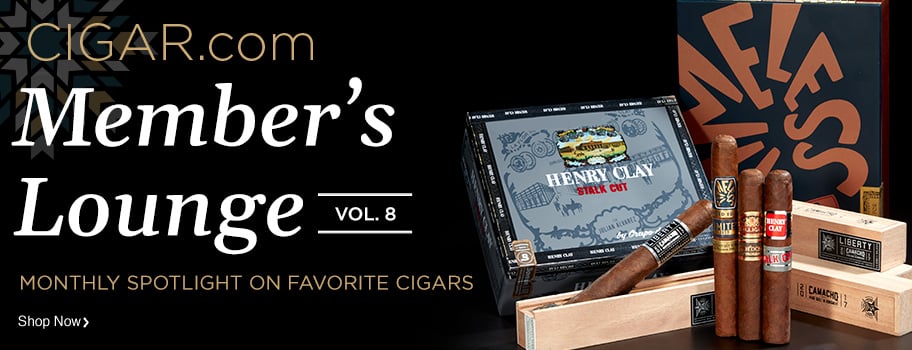
In the spirit of giving that
surrounds us during the holidays, I thought it seemed appropriate to present a
twist on the usual Member’s Lounge format: all four of the cigars featured this month will be on sale through
December 31st, 2020! Once
you learn more about these exceptional premiums, treat yourself by taking
advantage of special pricing before the New
Year.
NAT SHERMAN TIMELESS LE 2019
TORO
Nat Sherman. Just typing the name brings back a multitude of fond
memories, as the Sherman family gave me my start in the premium cigar industry
back in the mid-2000s. I grew up knowing the Sherman name as two generations of
my family smoked their cigars and pipe tobacco blends – my Great-Grandfather’s
insurance brokerage was even in the same building as Nat’s original store in
downtown Manhattan – the same Great-Grandfather who immigrated from Eastern
Europe as a 12-year-old child, only to wind up on the Lower East Side to learn
English selling cigars and cigarettes in a burlesque house. (Hey, it was a very
different time then!)
The story of Nat Sherman is the story
of an enterprising man. He ran a prominent speakeasy in New York during
Prohibition, and via family lore, became part owner of Traub Brothers and Bear,
a cigar maker who was then known for its Epoca brand. (The acquisition of this
business was the result of the settling of a gambling debt.) Epoca was made in
Havana and Tampa, and once Sherman saw the rise in profits by having his own
brand of premiums offered in his nightclub, he bought out his partner to become
sole owner.
Although Nat first had a small retail space in the
Financial District, the brand’s true major retail location was at 1400 Broadway
not far from Bryant Park. Prominent real estate developer Abe Gubertz had
cash-flow problems during the construction of his 38-story building at the
address, so Nat gave him a loan, accepting a piece of the lobby to sell Nat
Sherman cigars and cigarettes as partial repayment. Aside from selling in spades
to those who eventually worked in the building, Nat’s personality coupled with
the increasing popularity of his products garnered the attention of many a New
Yorker, as well as many a celebrity. At this time and until the embargo, Nat
Sherman was the exclusive importer and distributor of the Cuban-made Bolivar
brand in the US.
The 1950s through the mid-1980s continued to be
very successful for Nat and his brand. He was a pioneer in producing and mailing
out catalogues to all customers on his expansive mailing list, that way he could
ensure orders from those who didn’t live in New York, as well as further cement
himself as a national brand. He introduced the plastic-tipped cigar to the
industry, and was a pioneer in creating what was branded as a “luxury
cigarette,” which for Nat meant they were made of cigar tobacco instead of the
often-cheaper and harsher cigarette tobacco varietals. When the company expanded
to include pipes and pipe tobacco in the 1960s, Nat Sherman’s pipe department
was the biggest in New York and
nationwide.
After overseeing a clientele that consisted of
everyday people, the wealthy, mobsters, celebrities, and tourists for decades,
Nat passed away in 1989. The company had moved locations again earlier in 1976
to 711 Fifth Avenue – near the famous Plaza Hotel and across from Tiffany
& Co.’s former
headquarters – but a paradigm shift was about to begin. Cigars in general were
on the decline, and a lack of modernization within the branding of the Nat
Sherman portfolio began to take its effects on the company’s reputation as other
bigger (and former Cuban) brands started to cement themselves in the US
market.
Once the “cigar boom” came to fruition in the US, Nat
Sherman was kind of left behind. They had loyal cigar and cigarette customers,
but were unmentioned among a sea of new brands, new ideas, and new smokers who
often associated Sherman brand products with their Grandfathers. After multiple
turnovers in retail management and product development – and a couple of years
before the remaining Sherman family members sold the company to tobacco giant
Altria – the world was introduced to the Timeless
Collection.
What began with the Timeless Dominican release
made at MATASA (Quesada Cigars) had spurred the Timeless Nicaraguan made by
Plasencia.
(Both the Quesadas and the Plasencias are longtime friends of each other and the
Sherman family, as well as Michael Herklots.) Anyone familiar with older Sherman
branding knows that the look of the Timeless brand is quintessential Nat: the
Art Deco marquis font, the ode to the iconic clock, and the acknowledgment of
the brand’s beginnings in 1930. (Each cigar box even boasts a facsimile of
Sherman’s signature in a muted gold tone against matte black.) There is this
classic yet somewhat quiet elegance about it all which I personally find
amusing, as Nat often rattled off Borscht Belt one-liners, knew the cost down to
the penny of every single supply, and loved a rocks glass filled with
Dewar’s each Friday afternoon once the store
closed.
The Timeless Collection ushered in a new era for the
Sherman brand, both in terms of premium products available to consumers, but
also in terms of a swath of new clientele who may have never had a Sherman cigar
before. While both the Dominican and Nicaraguan blends have been rated ‘91’-plus
by Cigar Aficionado, this special, limited-edition set of
Timeless cigars is a must-have for any fan of this now sadly defunct New York
institution.
Packaged in stylish, 1930s-inspired boxes of five, this
blend is offered in a single Toro (6.0”x50) vitola. The binder and wrapper are
respectively comprised of lush leaves grown in the Dominican Republic, and the
long-filler blend from Nicaragua and the Dominican. Each premium presents a
medium to full-bodied profile, with the Timeless Limited Edition 2019 offering notes of cinnamon, leather, almonds,
and white pepper that will most assuredly keep you coming back for more. I urge
you to give this one a try one evening after a good meal. Heck, pour yourself a
glass of scotch like Nat would and finish the cigar down to the nub… You don’t
want Nat’s ghost chastising you about wasting money, do
you?
VILLIGER SAN’DORO COLORADO
ROBUSTO
Unless you are a fan of machine-made cigars or spend a lot of time
in Europe, the brand name Villiger might not have been terribly familiar to you
until a few years ago. They are a power-player within the industry worldwide,
but most know them for their Villiger
Exports – these small, trunk-pressed cigars in mid-century style
packaging – yet a change in philosophy circa 2013 allowed the Swiss company to
make a splash into the premium arena.
Founded in 1888 in Pfeffikon,
Switzerland by Jean Villiger, the company’s headquarters still remain there
today. Aficionados will know the name Heinrich Villiger – Jean’s grandson – is
still sharp, well-dressed, and sharp-minded, and at 90 years of age, continues
to steer the proverbial ship. Living in the US it might be hard to fathom, but
Villiger Söhne AG produces over a million European-style (dry cured) cigars per
year, and is the exclusive importer and distributor of Cuban cigars to five
different European countries. This is all in addition to its impressive
portfolio of premium cigars in the US, mind you, and a portfolio stateside that
continues to grow amid rave reviews.
Jean Villiger was not a tobacco man
at first, but he was a finance man, having managed one of the big cheroot
companies in the late 19th century. He wanted to open up his own factory, so his
then-boss loaned him the money. Unfortunately Jean died in 1902 at 42 years-old,
and for 16 years, his wife, Louise, ran the business and helped it to continue
on its successful path – something rarely heard of for that time. Their only
child was Heinrich’s father, and once he was old enough to take the helm, he did
so along with an uncle. Perhaps the most intriguing part of this early story is
that his uncle had no children, so when he was ready, that man sold his shares
to Heinrich’s father; once Heinrich’s father passed on, through the last will
and testament, Heinrich became the sole shareholder of Villiger
Cigars.
There was, however, this intermingling into the American
market many years ago: shortly after World War II, Villiger began the export of
their machine-made cigars to the US, as soldiers who fought in Germany became
fond of the products. (Germany is still their biggest market today, with
Villiger holding a 70% market share.) After completing formal training in raw
tobacco and keenly participating in tobacco auctions, a dashing young Heinrich
went off to New York City in 1964, and introduced his company at the prestigious
World’s Fair. Heinrich has made over 100 trips to Cuba for tobacco and
befriended some of the greatest names in business there, most notably the late
Don Alejandro Robaina. Interesting fact: after President Kennedy enacted the
embargo, the Cuban government specifically met with Villiger to offer them
never-before-seen grades of Cuban leaf, and thus ushering in an important
alliance between the fragile Cuba and powerhouse Swiss
economy.
While we’re technically here to talk premium cigars in
the States, I must preface that Villiger does not sneak any Cuban tobacco into
their handmades for the US market, so get that notion out of your head. Instead,
they still demand the highest quality leaf available, and given their ratings
and accolades from Cigar Aficionado, this small portion of
the company business is growing steadily. Villiger only opened up its North
American offices in Miami in 2016 – after the San’Doro Colorado began catching
the eyes of Cigar Aficionado the year
prior.
‘93’ rated, the San'Doro Colorado was named the #15 Cigar
of 2018 – the second time in its short life it was chosen to part of the
illustrious yearly list. Although production moved from the Oliva factory to
Joya de Nicaragua, everything about this premium continues to perform at a high
level befitting of its accolades. Its Ecuador Habano wrapper is dark and rich,
covering a Nicaraguan binder and long-filler blend that presents notes of baking
spices, coffee, leather, black pepper, cedar, and a malted-chocolate finish. A
true medium-bodied cigar, this is one I highly suggest buying enough to smoke
now and leave some for later, as a bit of aging leads to an even more luxurious
finish.
HENRY CLAY STALK CUT
ROBUSTO
Born in Virginia but making his career in Kentucky, Henry Clay Sr.
was an American attorney and statesman, having represented Kentucky in both the
House and the Senate. Clay was the seventh House Speaker, ninth Secretary of
State, and received electoral votes in three presidential elections over a span
of 20 years. He earned the nickname the “Great Compromiser” for his role in
diffusing sectional crises, but long-time cigar enthusiasts may think of Clay
with respect to his other role as a “War Hawk,” paying homage to the role he and
other young members of Congress played in pushing for a declaration of war
against in British in 1812.
A brand since the 1840s, the Henry
Clay cigars of yore were actually manufactured in Havana by Julian Alvarez.
Despite re-designs over time, the Cuban version of these premiums always
featured a portrait of the senator on the cigar band, and the brand was
extremely popular through the 19th Century. Author Rudyard Kipling of The Jungle
Book fame wrote a poem in 1898 titled The Betrothed, in which
he immortalized both the man and the cigar with his line, “There’s calm in a
Henry Clay.” Despite dying out around the Great Depression, the Henry
Clay brand was introduced to a new audience, as Tabacalera de García (owned by
Altadis USA), purchased the rights to the brand. Some versions were more
successful than others, but once Pete Johnson (Tatuaje
Cigars) proclaimed his affinity for this classic brand, the name Henry
Clay once again was discussed with prominence in cigar shops across the United
States.
After Altadis collaborated with Tatuaje to make a one-off
project called Henry Clay Tattoo, the cigar conglomerate took advantage of the
newfound attention and created the Henry Clay Stalk Cut. Quite simply, its name
refers to the harvesting method for the aged Broadleaf wrapper used for this
blend. Stalk cutting is the process in which the entire tobacco plant is chopped
at the base, and hung by its stalk to cure in a barn before final
fermentation(s) and then rolling.
Garnering a ‘92’ rating and having
been named the #22 Cigar of 2016, the entire blend is vintage-dated: the
Connecticut Broadleaf wrapper is from a 2012 harvest; the Dominican Piloto
binder from 2010; Dominican Piloto and Olor long-fillers are from 2012; and the
Nicaraguan Criollo long-fillers from 2013. Each premium is box-pressed, and
finished with the rustic charm of an uncut foot. Expect plenty of complexity and
nuance, and your palate will be greeted with hearty notes of baking spice, dark
chocolate, espresso, hay, almonds, and cedar. The Henry Clay line is sleepy no
more, and one you should not pass on if given the
chance!
CAMACHO LIBERTY 2017
TORO
While most seasoned enthusiasts were introduced to Camacho after
the late 20th-century “cigar boom,” few know that original brand owner Simon
Camacho opened Miami’s first cigar factory in 1961. Simon himself became exiled
from his native Cuba that same year, but he still found success in the US and
abroad, where even Mr. Winston Churchill was a fan. The hybridization of the
illustrious Cuban Corojo seeds in Hondura’s Jamastran Valley took time, but in
the end, it was worth all of the blood, sweat, and tears that went into making
the cigars we love today.
Five years after Simon Camacho’s
death, the Eiroa family purchased the rights to the brand in 1995. The Eiroas
had been growing tobacco in Cuba since the 1900s, but in the wake of the 1959
Revolution, the widow of family patriarch Generoso Eiroa fled to Tampa with her
three sons. One of Eiroa's sons, Julio, joined the Bay of Pigs invasion attempt
as special force of Cuban exiles working with the US Army. His brother, Generoso
Jr., worked in Nicaragua, while Julio traveled to Honduras in 1963 on behalf of
tobacco dealer Angel Oliva. There, as part of a government-sponsored cultivation
project, Julio laid the foundation for Camacho’s tobacco plantations eventually
belonging to the Eiroa family by the
mid-‘90s.
Global success was earned by the father-son leadership
team of Julio and Christian Eiroa, who reintroduced the Camacho name on a grand
scale. Numerous Cigar Aficionado ratings and accolades –
including bringing to market the world’s first triple maduro cigar – caught the
attention of aficionados around the world. Six years prior to selling both the
company and their Ranchos Jamastran factory in Honduras to Davidoff,
Camacho launched its Liberty Series.
A yearly, ultra-limited blend offered
in the company’s signature 11/18 vitola (a 6.0” x 48 x 54 x 48 figurado), and as
its name suggests, this cigar is about freedom. The Liberty Series is a
celebration of the pride and emancipation from tyranny felt by immigrants upon
arriving in the US, thus getting an opportunity to achieve the storied American
dream. And to answer your question about why Camacho named this special size
“11/18”? November 18th is the birthday of Christian Eiroa’s mother, so you can
put all of the conspiracy theories to rest
now.
The 2017 edition of Liberty was limited to just 2,500
boxes for the US market, and commemorated the 15th anniversary of this special
selection. While it sought to honor tradition, it also broke a proprietary mold:
still individually-coffined, the vitola is a 6.0”x54 Toro Extra. Liberty
2017 features a complex recipe of tobaccos, with an oily Ecuador Habano wrapper,
Honduran Corojo binder, and long-filler blend of Dominican Piloto Cubano and
Nicaraguan Corojo 99 leaves. Some may argue that not all yearly Liberty releases
are homeruns, but industry experts agree that 2017’s use of more Nicaraguan
tobacco here in comparison to other multi-country blends is what made this
edition a hit. Expect a spicy-sweet, earthy character with notes of coffee,
hazelnut, chocolate, cedar, and pepper. The finish is creamy and smooth, which
only lends to its overall
sophistication.
Whether you’re an enthusiast who likes to collect each
Liberty release, or you’re looking for an excuse to try one worth the price tag,
look no further than 2017.
In the spirit of giving that
surrounds us during the holidays, I thought it seemed appropriate to present a
twist on the usual Member’s Lounge format: all four of the cigars featured this month will be on sale through
December 31st, 2020! Once
you learn more about these exceptional premiums, treat yourself by taking
advantage of special pricing before the New
Year.
NAT SHERMAN TIMELESS LE 2019
TORO
Nat Sherman. Just typing the name brings back a multitude of fond
memories, as the Sherman family gave me my start in the premium cigar industry
back in the mid-2000s. I grew up knowing the Sherman name as two generations of
my family smoked their cigars and pipe tobacco blends – my Great-Grandfather’s
insurance brokerage was even in the same building as Nat’s original store in
downtown Manhattan – the same Great-Grandfather who immigrated from Eastern
Europe as a 12-year-old child, only to wind up on the Lower East Side to learn
English selling cigars and cigarettes in a burlesque house. (Hey, it was a very
different time then!)
The story of Nat Sherman is the story
of an enterprising man. He ran a prominent speakeasy in New York during
Prohibition, and via family lore, became part owner of Traub Brothers and Bear,
a cigar maker who was then known for its Epoca brand. (The acquisition of this
business was the result of the settling of a gambling debt.) Epoca was made in
Havana and Tampa, and once Sherman saw the rise in profits by having his own
brand of premiums offered in his nightclub, he bought out his partner to become
sole owner.
Although Nat first had a small retail space in the
Financial District, the brand’s true major retail location was at 1400 Broadway
not far from Bryant Park. Prominent real estate developer Abe Gubertz had
cash-flow problems during the construction of his 38-story building at the
address, so Nat gave him a loan, accepting a piece of the lobby to sell Nat
Sherman cigars and cigarettes as partial repayment. Aside from selling in spades
to those who eventually worked in the building, Nat’s personality coupled with
the increasing popularity of his products garnered the attention of many a New
Yorker, as well as many a celebrity. At this time and until the embargo, Nat
Sherman was the exclusive importer and distributor of the Cuban-made Bolivar
brand in the US.
The 1950s through the mid-1980s continued to be
very successful for Nat and his brand. He was a pioneer in producing and mailing
out catalogues to all customers on his expansive mailing list, that way he could
ensure orders from those who didn’t live in New York, as well as further cement
himself as a national brand. He introduced the plastic-tipped cigar to the
industry, and was a pioneer in creating what was branded as a “luxury
cigarette,” which for Nat meant they were made of cigar tobacco instead of the
often-cheaper and harsher cigarette tobacco varietals. When the company expanded
to include pipes and pipe tobacco in the 1960s, Nat Sherman’s pipe department
was the biggest in New York and
nationwide.
After overseeing a clientele that consisted of
everyday people, the wealthy, mobsters, celebrities, and tourists for decades,
Nat passed away in 1989. The company had moved locations again earlier in 1976
to 711 Fifth Avenue – near the famous Plaza Hotel and across from Tiffany
& Co.’s former
headquarters – but a paradigm shift was about to begin. Cigars in general were
on the decline, and a lack of modernization within the branding of the Nat
Sherman portfolio began to take its effects on the company’s reputation as other
bigger (and former Cuban) brands started to cement themselves in the US
market.
Once the “cigar boom” came to fruition in the US, Nat
Sherman was kind of left behind. They had loyal cigar and cigarette customers,
but were unmentioned among a sea of new brands, new ideas, and new smokers who
often associated Sherman brand products with their Grandfathers. After multiple
turnovers in retail management and product development – and a couple of years
before the remaining Sherman family members sold the company to tobacco giant
Altria – the world was introduced to the Timeless
Collection.
What began with the Timeless Dominican release
made at MATASA (Quesada Cigars) had spurred the Timeless Nicaraguan made by
Plasencia.
(Both the Quesadas and the Plasencias are longtime friends of each other and the
Sherman family, as well as Michael Herklots.) Anyone familiar with older Sherman
branding knows that the look of the Timeless brand is quintessential Nat: the
Art Deco marquis font, the ode to the iconic clock, and the acknowledgment of
the brand’s beginnings in 1930. (Each cigar box even boasts a facsimile of
Sherman’s signature in a muted gold tone against matte black.) There is this
classic yet somewhat quiet elegance about it all which I personally find
amusing, as Nat often rattled off Borscht Belt one-liners, knew the cost down to
the penny of every single supply, and loved a rocks glass filled with
Dewar’s each Friday afternoon once the store
closed.
The Timeless Collection ushered in a new era for the
Sherman brand, both in terms of premium products available to consumers, but
also in terms of a swath of new clientele who may have never had a Sherman cigar
before. While both the Dominican and Nicaraguan blends have been rated ‘91’-plus
by Cigar Aficionado, this special, limited-edition set of
Timeless cigars is a must-have for any fan of this now sadly defunct New York
institution.
Packaged in stylish, 1930s-inspired boxes of five, this
blend is offered in a single Toro (6.0”x50) vitola. The binder and wrapper are
respectively comprised of lush leaves grown in the Dominican Republic, and the
long-filler blend from Nicaragua and the Dominican. Each premium presents a
medium to full-bodied profile, with the Timeless Limited Edition 2019 offering notes of cinnamon, leather, almonds,
and white pepper that will most assuredly keep you coming back for more. I urge
you to give this one a try one evening after a good meal. Heck, pour yourself a
glass of scotch like Nat would and finish the cigar down to the nub… You don’t
want Nat’s ghost chastising you about wasting money, do
you?
VILLIGER SAN’DORO COLORADO
ROBUSTO
Unless you are a fan of machine-made cigars or spend a lot of time
in Europe, the brand name Villiger might not have been terribly familiar to you
until a few years ago. They are a power-player within the industry worldwide,
but most know them for their Villiger
Exports – these small, trunk-pressed cigars in mid-century style
packaging – yet a change in philosophy circa 2013 allowed the Swiss company to
make a splash into the premium arena.
Founded in 1888 in Pfeffikon,
Switzerland by Jean Villiger, the company’s headquarters still remain there
today. Aficionados will know the name Heinrich Villiger – Jean’s grandson – is
still sharp, well-dressed, and sharp-minded, and at 90 years of age, continues
to steer the proverbial ship. Living in the US it might be hard to fathom, but
Villiger Söhne AG produces over a million European-style (dry cured) cigars per
year, and is the exclusive importer and distributor of Cuban cigars to five
different European countries. This is all in addition to its impressive
portfolio of premium cigars in the US, mind you, and a portfolio stateside that
continues to grow amid rave reviews.
Jean Villiger was not a tobacco man
at first, but he was a finance man, having managed one of the big cheroot
companies in the late 19th century. He wanted to open up his own factory, so his
then-boss loaned him the money. Unfortunately Jean died in 1902 at 42 years-old,
and for 16 years, his wife, Louise, ran the business and helped it to continue
on its successful path – something rarely heard of for that time. Their only
child was Heinrich’s father, and once he was old enough to take the helm, he did
so along with an uncle. Perhaps the most intriguing part of this early story is
that his uncle had no children, so when he was ready, that man sold his shares
to Heinrich’s father; once Heinrich’s father passed on, through the last will
and testament, Heinrich became the sole shareholder of Villiger
Cigars.
There was, however, this intermingling into the American
market many years ago: shortly after World War II, Villiger began the export of
their machine-made cigars to the US, as soldiers who fought in Germany became
fond of the products. (Germany is still their biggest market today, with
Villiger holding a 70% market share.) After completing formal training in raw
tobacco and keenly participating in tobacco auctions, a dashing young Heinrich
went off to New York City in 1964, and introduced his company at the prestigious
World’s Fair. Heinrich has made over 100 trips to Cuba for tobacco and
befriended some of the greatest names in business there, most notably the late
Don Alejandro Robaina. Interesting fact: after President Kennedy enacted the
embargo, the Cuban government specifically met with Villiger to offer them
never-before-seen grades of Cuban leaf, and thus ushering in an important
alliance between the fragile Cuba and powerhouse Swiss
economy.
While we’re technically here to talk premium cigars in
the States, I must preface that Villiger does not sneak any Cuban tobacco into
their handmades for the US market, so get that notion out of your head. Instead,
they still demand the highest quality leaf available, and given their ratings
and accolades from Cigar Aficionado, this small portion of
the company business is growing steadily. Villiger only opened up its North
American offices in Miami in 2016 – after the San’Doro Colorado began catching
the eyes of Cigar Aficionado the year
prior.
‘93’ rated, the San'Doro Colorado was named the #15 Cigar
of 2018 – the second time in its short life it was chosen to part of the
illustrious yearly list. Although production moved from the Oliva factory to
Joya de Nicaragua, everything about this premium continues to perform at a high
level befitting of its accolades. Its Ecuador Habano wrapper is dark and rich,
covering a Nicaraguan binder and long-filler blend that presents notes of baking
spices, coffee, leather, black pepper, cedar, and a malted-chocolate finish. A
true medium-bodied cigar, this is one I highly suggest buying enough to smoke
now and leave some for later, as a bit of aging leads to an even more luxurious
finish.
HENRY CLAY STALK CUT
ROBUSTO
Born in Virginia but making his career in Kentucky, Henry Clay Sr.
was an American attorney and statesman, having represented Kentucky in both the
House and the Senate. Clay was the seventh House Speaker, ninth Secretary of
State, and received electoral votes in three presidential elections over a span
of 20 years. He earned the nickname the “Great Compromiser” for his role in
diffusing sectional crises, but long-time cigar enthusiasts may think of Clay
with respect to his other role as a “War Hawk,” paying homage to the role he and
other young members of Congress played in pushing for a declaration of war
against in British in 1812.
A brand since the 1840s, the Henry
Clay cigars of yore were actually manufactured in Havana by Julian Alvarez.
Despite re-designs over time, the Cuban version of these premiums always
featured a portrait of the senator on the cigar band, and the brand was
extremely popular through the 19th Century. Author Rudyard Kipling of The Jungle
Book fame wrote a poem in 1898 titled The Betrothed, in which
he immortalized both the man and the cigar with his line, “There’s calm in a
Henry Clay.” Despite dying out around the Great Depression, the Henry
Clay brand was introduced to a new audience, as Tabacalera de García (owned by
Altadis USA), purchased the rights to the brand. Some versions were more
successful than others, but once Pete Johnson (Tatuaje
Cigars) proclaimed his affinity for this classic brand, the name Henry
Clay once again was discussed with prominence in cigar shops across the United
States.
After Altadis collaborated with Tatuaje to make a one-off
project called Henry Clay Tattoo, the cigar conglomerate took advantage of the
newfound attention and created the Henry Clay Stalk Cut. Quite simply, its name
refers to the harvesting method for the aged Broadleaf wrapper used for this
blend. Stalk cutting is the process in which the entire tobacco plant is chopped
at the base, and hung by its stalk to cure in a barn before final
fermentation(s) and then rolling.
Garnering a ‘92’ rating and having
been named the #22 Cigar of 2016, the entire blend is vintage-dated: the
Connecticut Broadleaf wrapper is from a 2012 harvest; the Dominican Piloto
binder from 2010; Dominican Piloto and Olor long-fillers are from 2012; and the
Nicaraguan Criollo long-fillers from 2013. Each premium is box-pressed, and
finished with the rustic charm of an uncut foot. Expect plenty of complexity and
nuance, and your palate will be greeted with hearty notes of baking spice, dark
chocolate, espresso, hay, almonds, and cedar. The Henry Clay line is sleepy no
more, and one you should not pass on if given the
chance!
CAMACHO LIBERTY 2017
TORO
While most seasoned enthusiasts were introduced to Camacho after
the late 20th-century “cigar boom,” few know that original brand owner Simon
Camacho opened Miami’s first cigar factory in 1961. Simon himself became exiled
from his native Cuba that same year, but he still found success in the US and
abroad, where even Mr. Winston Churchill was a fan. The hybridization of the
illustrious Cuban Corojo seeds in Hondura’s Jamastran Valley took time, but in
the end, it was worth all of the blood, sweat, and tears that went into making
the cigars we love today.
Five years after Simon Camacho’s
death, the Eiroa family purchased the rights to the brand in 1995. The Eiroas
had been growing tobacco in Cuba since the 1900s, but in the wake of the 1959
Revolution, the widow of family patriarch Generoso Eiroa fled to Tampa with her
three sons. One of Eiroa's sons, Julio, joined the Bay of Pigs invasion attempt
as special force of Cuban exiles working with the US Army. His brother, Generoso
Jr., worked in Nicaragua, while Julio traveled to Honduras in 1963 on behalf of
tobacco dealer Angel Oliva. There, as part of a government-sponsored cultivation
project, Julio laid the foundation for Camacho’s tobacco plantations eventually
belonging to the Eiroa family by the
mid-‘90s.
Global success was earned by the father-son leadership
team of Julio and Christian Eiroa, who reintroduced the Camacho name on a grand
scale. Numerous Cigar Aficionado ratings and accolades –
including bringing to market the world’s first triple maduro cigar – caught the
attention of aficionados around the world. Six years prior to selling both the
company and their Ranchos Jamastran factory in Honduras to Davidoff,
Camacho launched its Liberty Series.
A yearly, ultra-limited blend offered
in the company’s signature 11/18 vitola (a 6.0” x 48 x 54 x 48 figurado), and as
its name suggests, this cigar is about freedom. The Liberty Series is a
celebration of the pride and emancipation from tyranny felt by immigrants upon
arriving in the US, thus getting an opportunity to achieve the storied American
dream. And to answer your question about why Camacho named this special size
“11/18”? November 18th is the birthday of Christian Eiroa’s mother, so you can
put all of the conspiracy theories to rest
now.
The 2017 edition of Liberty was limited to just 2,500
boxes for the US market, and commemorated the 15th anniversary of this special
selection. While it sought to honor tradition, it also broke a proprietary mold:
still individually-coffined, the vitola is a 6.0”x54 Toro Extra. Liberty
2017 features a complex recipe of tobaccos, with an oily Ecuador Habano wrapper,
Honduran Corojo binder, and long-filler blend of Dominican Piloto Cubano and
Nicaraguan Corojo 99 leaves. Some may argue that not all yearly Liberty releases
are homeruns, but industry experts agree that 2017’s use of more Nicaraguan
tobacco here in comparison to other multi-country blends is what made this
edition a hit. Expect a spicy-sweet, earthy character with notes of coffee,
hazelnut, chocolate, cedar, and pepper. The finish is creamy and smooth, which
only lends to its overall
sophistication.
Whether you’re an enthusiast who likes to collect each
Liberty release, or you’re looking for an excuse to try one worth the price tag,
look no further than 2017.
Email Sign Up
Stay connected and sign-up for emails to get exclusive deals and event info.
Welcome, and thank you for joining the CIGAR.com community. We are the Home for Cigar Enthusiasts - it's our passion. Keep an eye out on your inbox for early access to new arrivals and exclusive promotions.
Product Re-Stock Notification
You have exceeded the allowable number of different credit cards attempted
No further attempts will be allowed online. For security purposes, please call our customer service department at 1-800-357-9800 if you still wish to complete your order.