It should come as no surprise
that everyone at CIGAR.com loves cigars and premium tobacco, and it’s truly a
passion we convey to all customers, but what about an even more detailed
discussion?
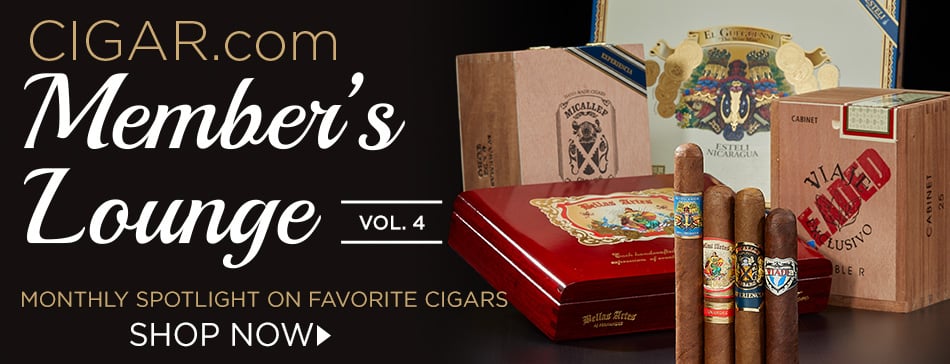
Welcome to the Member’s
Lounge, a monthly digest where the current “top picks” around the CIGAR.com
office are highlighted. Let us provide the same detailed scoop you'd come to
expect if we sat down in a smoking lounge together, as we share our knowledge
and passion for all things cigar with
you.
These days it’s difficult to imagine the modern
cigar market without Abdel “AJ” Fernandez. The Cuban émigré left Pinar del Rio
in 2003 and settled in Estelí as a third generation grower, blender, and
manufacturer. Prolific doesn’t accurately describe his company’s output, as
they’re responsible for everything from seedling to finished product – AJ even
has the boxes made for his proprietary blends on-site. Aside from reviving his
Grandfather’s brand, San Lotano, AJ has worked for clients like Rocky Patel and
Altadis, which led to owning one of Nicaragua’s largest premium cigar
operations, Tabacalera Fernandez. A proud immigrant, AJ unabashedly praises his
adopted country. His greatest joy seems to be succeeding in the industry he
loves, knowing that alongside him the people of Nicaragua prosper,
too.
The
Bellas Artes cigar is inspired by the
Museo Nacional de Bellas Artes in Cuba (National Museum of
Fine Arts), and there are many parallels which can be drawn from Fernandez’s
muse and his own life. There is this acknowledgement of the
mestizo, a term which while meaning “mixed,” specifically
refers to those who have both Indigenous and White European ancestry. The ornate
main band on this cigar is truly a nod to the Taíno and Spanish, and done in a
style representative of many paintings found in the museum’s Arte en la
Colonia XVI – XIX collection. Note the imagery of a Taíno woman
carrying a bundle of freshly-cut tobacco leaves at the foot of a European woman
who’s holding a shield with the crest of Old Havana City: to the right a Cuban
flag and coins which symbolize the Spanish; to the left a Nicaraguan flag, the
Cuban crest, and conquistador imagery. Scattered in the background are both
boxes and mazos of cigars, white mariposas (Cuba’s national flower), and cherubs
floating reminiscent of the same iconography associated with La Caridad
del Cobre, Cuba’s patron
saint.
The
cigar made its debut in the industry four years ago this month at the
then-IPCPR’s 2016 trade show in Las Vegas. Fernandez made Bellas Artes with a
combination of unique, hybrid tobaccos aged for a minimum of three years: do you
see yet another important parallel here? He literally grew raw materials which
together as a blend, over time intermingle and marry their prominent qualities,
resulting in a cigar which is wholly indicative of the Cuban people. Okay, I’ve
fed you enough history and allegory, so what should you expect from your smoking
experience?
Hailing from AJ’s factory in Nicaragua, Bellas Artes features Rojita, a
hybrid wrapper which contains cross-strains of Connecticut 8212, Corojo 99, and
Havana 2000. Its binder is a Havana 92 varietal grown in the Quilalí region of
Nicaragua, an area which has been producing black tobacco since the 19th
Century. Although the long-filler blend is predominately Nicaraguan from Estelí,
Condega, and Jalapa, Fernandez added a bit of Jamastran leaf (Honduras) as well
as Viso from Mata Norte in Brazil, which not only provides sweetness, but also a
burst of nicotine. The result is a medium to full-bodied blend billowing with
big flavors and a slow burn. Look for notes of pepper, cream, honey, anise,
earth, and fermented yeast, as Bellas Artes by AJ Fernandez is a cigar that
smokes like a bold bourbon.
Micallef Experiencia La
Crema
I don’t think it’s unusual for a seasoned cigar enthusiast to
fantasize about breaking into the industry, but few ever do: it’s costly, a lot
of work, and not very profitable. Perhaps it was a lot easier before things got
political, but my point is that one would need to have the right connections and
fair amount of capital in order to start off on the right foot. There’s an old
joke which asks, “How do you make a million dollars in the cigar business?” The
answer is, “Start with two million.” Speaking of millions, let me introduce you
to Al Micallef.
Al
is a Texan who is described as a “serial entrepreneur,” having invested in and
started a variety of ventures. He owns restaurants, an automotive supply
business, a silicone rubber company, and a high-volume cattle ranch, and has
also been a cigar smoker for nearly 30 years. Oddly enough it was his cattle
ranch in Alpine, Texas which gave birth to Micallef’s love of the leaf, as his
wife doesn’t let him smoke inside their Fort Worth-area home. Al didn’t have
direct plans per se to enter into the cigar business, but one Friday night while
smoking at Downtown Fort Worth’s Silverleaf Lounge, it seemed that fate
intervened.
A
broken-down SUV driven by Joel and Edel Gómez Sanchez pulled up in front of
Silverleaf, and seeing as they are the third generation cigar makers, they
walked into the busy lounge expecting to find a familiar atmosphere. Lounge
Manager Jake Kestleoot had no idea who these men were, but with supplies in-hand
and a quick introduction, the Cuban brothers set up a rolling table to pass out
samples to customers and were an instant hit. What was supposed to be a quick
stop before a mechanic could fix their vehicle turned into a three-day
residency, and Al Micallef was impressed – and rightfully so given the Gómez
Sanchez pedigree. Micallef ordered 1,000 cigars from the two brothers before
they left for Florida, and this was the beginning of the brand. But before I
continue on, I’d be remiss to not shed some light on the legacy of Pedro F.
Gómez and his family.
Born in Pinar del Río, Pedro started an
apprenticeship in a local factory at the age of 11 in 1924, and moved to Havana
one year later. Gómez spent the first half of his career crafting H. Upmann
cigars before becoming the Production Master of factories in the Dominican
Republic, Honduras, Mexico, Miami, and Nicaragua. His daughter-in-law is
Migdalia Sanchez, who started her studies at age 16 at the School of
Tobacconists in Havana. She graduated within one year and quickly became one of
the best rollers at the legendary Partagás Factory; also chosen by the Cuban
government to represent the island at different international expositions, her
talents caught the attention of Fidel Castro, and she was often commissioned to
roll cigars for the controversial leader. Her three children, Joel, Edel, and
Mabel Gómez Sanchez have also dedicated their lives to tobacco in Cuba before
defecting to the US in the 1990s. Joel and Edel followed in their family’s
footsteps having rolled at Partagás and H. Upmann before leaving Cuba for Miami,
and eventually Mexico, where they learned from their Grandfather up until the
day he passed in 2002. Splitting their time between Miami and Estelí, both Joel,
Edel, and Migdalia are active participants in their family’s business,
maintaining the legacy begun by Pedro nearly a century
ago.
Al
Micallef attributes his newfound success in the cigar business to a mixture of
curiosity, a love of new challenges, and an admiration for the craft. Officially
having launched his namesake brand in April 2017, the cigars were originally
more expensive than they are today – some selling for upwards of $42 apiece –
but the need for better pricing and opportunity for expansion led to Al having
purchased his own factory in Estelí. He claims that 95% of his time is spent
nurturing his burgeoning premium tobacco efforts, as all of his other ventures
are mature and stable. Part of the “Legacy” line in the Micallef portfolio, the
Experiencia La Crema received a ‘90’ rating by Cigar
Aficionado shortly after its release. To date, six different Micallef
blends are the recipients of 90+ ratings, and this young brand made its first
Top 25 List appearance after barely 18 months in
business.
Part of the recipe for success with the Micallef Experiencia La
Crema blend lies in a century-old triple fermentation process supervised by Joel
and Edel Gómez Sanchez. Small-batch tobaccos are harvested at their peak; the
blend consists of a San Andrés Sumatra wrapper, Ecuadorian Habano binder, and a
combination of Nicaraguan, Dominican, and Panamanian long-fillers, with all
components having each been aged for four years. Medium-bodied, throughout a
slow and even burning process the palate is met with black pepper, cocoa, brown
sugar, and a delightful floral quality. While the company doesn’t seem to do much in the
way of advertising, if my opinions mean anything to you, please know that I
quite literally shouted “these are box-worthy!” after I finished my first
Experiencia La Crema over a year ago in the CIGAR.com offices. I’m a big
proponent of most Micallef blends, as they’re easy to smoke: I enjoy them while
working as well as relaxing; with coffee or water, as well as with a stiff
drink. There’s this familiarity in their delivery which can be taken for face
value, or as I often do, examine them with a fine-tooth comb. Either way, I love
them and think if you haven’t yet been introduced to Micallef Cigars, there’s no
time like the present.
El Güegüense
Churchill
Nicholas Melillo, owner of Foundation Cigar
Company, is a bit of a cult figure among various sects of cigar enthusiasts. He
went independent in 2015 with Foundation, but he’s spent over 20 years traveling
the world and working with some of the best farmers, fellow Master Blenders, and
top rollers in the business to hone his craft and his vision. A native of
Connecticut, Nick grew up around the farms in the River Valley that once
predominately grew Shade tobacco, but more recently due to a change in consumer
demand, almost entirely grows Broadleaf. Both of his grandfathers smoked
Broadleaf cigars, so he was familiar with the finicky tobacco from a young age.
At 18 years-old, Nick sat down with his brother and one of their grandfathers to
smoke his first cigar – obviously a key moment in a young man’s life, but even
more so for Melillo as his work early on would be marked by his skills with his
hometown crop.
Upon graduating from High School, Nick was a full-on enthusiast, and
seeing as this was during the infamous “cigar boom” of the 1990s, he could often
be found at his local brick-and-mortar waiting with tons of fellow enthusiasts
looking to procure the newest releases. A week prior to beginning his freshman
year of college, Melillo was hired to run the shop’s humidor, a job he
essentially asked for during one of his frequent shopping trips. In 1998 while
still working at the shop, there was a Drew Estate event with Jonathan Drew in
attendance. The two became fast friends, exchanged contact information, and kept
in touch for years. Nick moved to Italy after graduation to work for the
Vatican, returned to Connecticut briefly in 2001 to start a Master’s Degree, and
then went back to Italy after deciding to not pursue higher education after all.
Traveling the world in his spare time, one day while all the way over in Japan,
Melillo got an email from Jonathan Drew offering him a position at Drew Estate –
in Estelí.
In
2003 Nick moved to Nicaragua, and immersed himself in everything premium
tobacco: factory operations, leaf operations, blending, and packaging. He
befriended a number of long-time personnel even at other companies in an effort
to truly understand the business from seedling to finished product. In his
11-year tenure at Drew Estate, Melillo was directly responsible for blending
some of the company’s top-selling brands, including Liga Privada No. 9, T52,
Dirty Rat, L40, and Nica Rustica to name a few. Looming FDA regulations and
anti-tobacco legislation which began to seriously threaten the industry as a
whole got him thinking: despite a successful run as EVP of Drew Estate, if Nick
didn’t leave to start his own company, he might never have the
chance.
I’m
not certain many industry professionals would argue with me when I say that out
of all of the gringos who went to Nicaragua to work
the cigar business, Nick embraced the people, the culture, and the history most
sincerely. (He’s even known by many enthusiasts as “Nick-R-Agua,” which is a fun
play on his name and that of his second home.) There’s nothing about his
portfolio that feels feigned or even over-the-top – it’s simply another means
for Melillo to express his continuing adoration for the Central American
country. My hypothesis is further propagated by El Güegüense, or “The Wise Man,” which
was made to be Foundation Cigars’ first major
release.
El Güegüense is satire, and the first literary
work in post-Colombian Nicaragua – it’s seen as one of Latin America’s most
distinctive colonial era expressions, serving as the country’s signature
folkloric masterpiece combining dance, music, and theatre. Although the play is
the work of an anonymous author in the 16th Century, it was orally transmitted
in Nahautl and Spanish until it was finally written down and published in 1942.
Due to its all-encompassing representation of Nicaraguan folklore, UNESCO
proclaimed it a “Masterpiece of Oral and Intangible Heritage of Humanity” in
2005; there’s even a monument built in its honor in Managua. To say this image,
its theatrical narrative, and its cast of characters is important to Nicaragua
is an understatement.
The cigar of the same name is a
puro made from bales hand-selected by Melillo. Both wrapper
and binder are Corojo 99 Jalapa, and the Corojo 99 and Criollo 98 long-filler
blend stem from a special vintage crop from 2011 and 2012. Nick personally
oversees production of
El Güegüense at the TABSA facilities, which is limited to 225 units
per day. A medium-bodied blend with notes of cedar, baking spice, dried fruit,
pepper, espresso, and earth, all cigars are aged in cedar before release. No
stranger to praise, Nick Melillo’s first solo effort earned him a ‘92’ from
Cigar Aficionado and a Top 25 List spot. Then again, what
else would you expect from a kid who was gifted a Diamond Crown humidor for a
High School graduation gift?
Viaje Exclusivo Nicaragua Leaded Double
R
Using the Spanish word for “journey” as its name, Viaje is nothing
short of a boutique that’s always in-demand. Owner and President Andre Farkas is
a bit of an enigma in the industry as he’s not one to attend many events or be
present on social media, but he has established his brand as one that
specializes in the small batch approach. In what little promotional material
Viaje uses, Farkas is adamant that he himself is a boutique cigar enthusiast,
and therefore as owner, he promises to deliver what he prefers, and that is not
the mass-produced blend.
The Exclusivo Nicaragua Leaded
line began its life as an event-only cigar years ago, and was designed as the
fuller-bodied counterpart to the original Exclusivo. While not the first blend
to be subject to overwhelming demand, the Exclusivo Nicaragua Leaded is one of
the first to become a regular production blend, albeit still made in small
batches. In fact, Farkas himself refers to this cigar as his “personal blend”
and one he enjoys every day.
Rolled in Casa Fernandez’s Tabacos
Valle de Jalapa factory (aka TABSA), the Exclusivo Nicaragua Leaded consists of
the same premium tobacco as the original Exclusivo, but added to the recipe are
Medio Tiempo leaves which create a fuller-bodied blend with prominent spice.
When talking growing and harvesting, the tobacco plant is always divided into
sections from the bottom to the top: Volado, Seco, Viso,
and Ligero. To put it in perspective, Medio
Tiempo is harvested from the very top of the plant – higher up than
the Ligero – in two areas referred to as the Corona
and the Picadura. Given that the two upper-most
parts of the plant receive maximum sun exposure, utilizing any part of the crop
in a blend will automatically increase its overall strength and flavor profile,
and thus it must be used very carefully. Medio Tiempo isn’t used widely, but it
does have a home in other well-known puros such as Joya de
Nicaragua’s Antaño 1970, where it’s been used consistently since 1999. (The
folks at Joya actually refer to it as Ligerón, which without
going on a tangent about Spanish language mechanics essentially means “very
Ligero,” or “Ligero-plus.”)
This Nicaraguan
puro is a powerhouse, but it’s something that can be enjoyed
both right now as well as allowing it to continue aging in your humidor. The
burn, the draw, and the roll on the Exclusivo Leaded are all done well, which
only serves to enhance the smoking experience. From first light there is a
variety of pepper and earthiness, so if you don’t often smoke full-bodied,
full-profile premiums, prepare yourself: it’s kind of like the tobacco
equivalent of eating something you know is spicy, but comes in layers. As the
burn line inches downward, the spice notes alternate between a dry white pepper
and a smoked chile árbol, with instances of honey sweetness
and notes of dried fruit that seem to hit the palate just when it needs a
reprieve. It does burn a hot at the end, so if you’re one to “nub,” you might
want to grab your cigar poker. While I’d normally advocate the retrohale, please
proceed with caution here: unless you want to only taste the equivalent of a
Memphis BBQ meets Mexico dry rub after you’ve finished – smoke this cigar calmly
as a post-dinner delight.
It should come as no surprise
that everyone at CIGAR.com loves cigars and premium tobacco, and it’s truly a
passion we convey to all customers, but what about an even more detailed
discussion?
Welcome to the Member’s
Lounge, a monthly digest where the current “top picks” around the CIGAR.com
office are highlighted. Let us provide the same detailed scoop you'd come to
expect if we sat down in a smoking lounge together, as we share our knowledge
and passion for all things cigar with
you.
These days it’s difficult to imagine the modern
cigar market without Abdel “AJ” Fernandez. The Cuban émigré left Pinar del Rio
in 2003 and settled in Estelí as a third generation grower, blender, and
manufacturer. Prolific doesn’t accurately describe his company’s output, as
they’re responsible for everything from seedling to finished product – AJ even
has the boxes made for his proprietary blends on-site. Aside from reviving his
Grandfather’s brand, San Lotano, AJ has worked for clients like Rocky Patel and
Altadis, which led to owning one of Nicaragua’s largest premium cigar
operations, Tabacalera Fernandez. A proud immigrant, AJ unabashedly praises his
adopted country. His greatest joy seems to be succeeding in the industry he
loves, knowing that alongside him the people of Nicaragua prosper,
too.
The
Bellas Artes cigar is inspired by the
Museo Nacional de Bellas Artes in Cuba (National Museum of
Fine Arts), and there are many parallels which can be drawn from Fernandez’s
muse and his own life. There is this acknowledgement of the
mestizo, a term which while meaning “mixed,” specifically
refers to those who have both Indigenous and White European ancestry. The ornate
main band on this cigar is truly a nod to the Taíno and Spanish, and done in a
style representative of many paintings found in the museum’s Arte en la
Colonia XVI – XIX collection. Note the imagery of a Taíno woman
carrying a bundle of freshly-cut tobacco leaves at the foot of a European woman
who’s holding a shield with the crest of Old Havana City: to the right a Cuban
flag and coins which symbolize the Spanish; to the left a Nicaraguan flag, the
Cuban crest, and conquistador imagery. Scattered in the background are both
boxes and mazos of cigars, white mariposas (Cuba’s national flower), and cherubs
floating reminiscent of the same iconography associated with La Caridad
del Cobre, Cuba’s patron
saint.
The
cigar made its debut in the industry four years ago this month at the
then-IPCPR’s 2016 trade show in Las Vegas. Fernandez made Bellas Artes with a
combination of unique, hybrid tobaccos aged for a minimum of three years: do you
see yet another important parallel here? He literally grew raw materials which
together as a blend, over time intermingle and marry their prominent qualities,
resulting in a cigar which is wholly indicative of the Cuban people. Okay, I’ve
fed you enough history and allegory, so what should you expect from your smoking
experience?
Hailing from AJ’s factory in Nicaragua, Bellas Artes features Rojita, a
hybrid wrapper which contains cross-strains of Connecticut 8212, Corojo 99, and
Havana 2000. Its binder is a Havana 92 varietal grown in the Quilalí region of
Nicaragua, an area which has been producing black tobacco since the 19th
Century. Although the long-filler blend is predominately Nicaraguan from Estelí,
Condega, and Jalapa, Fernandez added a bit of Jamastran leaf (Honduras) as well
as Viso from Mata Norte in Brazil, which not only provides sweetness, but also a
burst of nicotine. The result is a medium to full-bodied blend billowing with
big flavors and a slow burn. Look for notes of pepper, cream, honey, anise,
earth, and fermented yeast, as Bellas Artes by AJ Fernandez is a cigar that
smokes like a bold bourbon.
Micallef Experiencia La
Crema
I don’t think it’s unusual for a seasoned cigar enthusiast to
fantasize about breaking into the industry, but few ever do: it’s costly, a lot
of work, and not very profitable. Perhaps it was a lot easier before things got
political, but my point is that one would need to have the right connections and
fair amount of capital in order to start off on the right foot. There’s an old
joke which asks, “How do you make a million dollars in the cigar business?” The
answer is, “Start with two million.” Speaking of millions, let me introduce you
to Al Micallef.
Al
is a Texan who is described as a “serial entrepreneur,” having invested in and
started a variety of ventures. He owns restaurants, an automotive supply
business, a silicone rubber company, and a high-volume cattle ranch, and has
also been a cigar smoker for nearly 30 years. Oddly enough it was his cattle
ranch in Alpine, Texas which gave birth to Micallef’s love of the leaf, as his
wife doesn’t let him smoke inside their Fort Worth-area home. Al didn’t have
direct plans per se to enter into the cigar business, but one Friday night while
smoking at Downtown Fort Worth’s Silverleaf Lounge, it seemed that fate
intervened.
A
broken-down SUV driven by Joel and Edel Gómez Sanchez pulled up in front of
Silverleaf, and seeing as they are the third generation cigar makers, they
walked into the busy lounge expecting to find a familiar atmosphere. Lounge
Manager Jake Kestleoot had no idea who these men were, but with supplies in-hand
and a quick introduction, the Cuban brothers set up a rolling table to pass out
samples to customers and were an instant hit. What was supposed to be a quick
stop before a mechanic could fix their vehicle turned into a three-day
residency, and Al Micallef was impressed – and rightfully so given the Gómez
Sanchez pedigree. Micallef ordered 1,000 cigars from the two brothers before
they left for Florida, and this was the beginning of the brand. But before I
continue on, I’d be remiss to not shed some light on the legacy of Pedro F.
Gómez and his family.
Born in Pinar del Río, Pedro started an
apprenticeship in a local factory at the age of 11 in 1924, and moved to Havana
one year later. Gómez spent the first half of his career crafting H. Upmann
cigars before becoming the Production Master of factories in the Dominican
Republic, Honduras, Mexico, Miami, and Nicaragua. His daughter-in-law is
Migdalia Sanchez, who started her studies at age 16 at the School of
Tobacconists in Havana. She graduated within one year and quickly became one of
the best rollers at the legendary Partagás Factory; also chosen by the Cuban
government to represent the island at different international expositions, her
talents caught the attention of Fidel Castro, and she was often commissioned to
roll cigars for the controversial leader. Her three children, Joel, Edel, and
Mabel Gómez Sanchez have also dedicated their lives to tobacco in Cuba before
defecting to the US in the 1990s. Joel and Edel followed in their family’s
footsteps having rolled at Partagás and H. Upmann before leaving Cuba for Miami,
and eventually Mexico, where they learned from their Grandfather up until the
day he passed in 2002. Splitting their time between Miami and Estelí, both Joel,
Edel, and Migdalia are active participants in their family’s business,
maintaining the legacy begun by Pedro nearly a century
ago.
Al
Micallef attributes his newfound success in the cigar business to a mixture of
curiosity, a love of new challenges, and an admiration for the craft. Officially
having launched his namesake brand in April 2017, the cigars were originally
more expensive than they are today – some selling for upwards of $42 apiece –
but the need for better pricing and opportunity for expansion led to Al having
purchased his own factory in Estelí. He claims that 95% of his time is spent
nurturing his burgeoning premium tobacco efforts, as all of his other ventures
are mature and stable. Part of the “Legacy” line in the Micallef portfolio, the
Experiencia La Crema received a ‘90’ rating by Cigar
Aficionado shortly after its release. To date, six different Micallef
blends are the recipients of 90+ ratings, and this young brand made its first
Top 25 List appearance after barely 18 months in
business.
Part of the recipe for success with the Micallef Experiencia La
Crema blend lies in a century-old triple fermentation process supervised by Joel
and Edel Gómez Sanchez. Small-batch tobaccos are harvested at their peak; the
blend consists of a San Andrés Sumatra wrapper, Ecuadorian Habano binder, and a
combination of Nicaraguan, Dominican, and Panamanian long-fillers, with all
components having each been aged for four years. Medium-bodied, throughout a
slow and even burning process the palate is met with black pepper, cocoa, brown
sugar, and a delightful floral quality. While the company doesn’t seem to do much in the
way of advertising, if my opinions mean anything to you, please know that I
quite literally shouted “these are box-worthy!” after I finished my first
Experiencia La Crema over a year ago in the CIGAR.com offices. I’m a big
proponent of most Micallef blends, as they’re easy to smoke: I enjoy them while
working as well as relaxing; with coffee or water, as well as with a stiff
drink. There’s this familiarity in their delivery which can be taken for face
value, or as I often do, examine them with a fine-tooth comb. Either way, I love
them and think if you haven’t yet been introduced to Micallef Cigars, there’s no
time like the present.
El Güegüense
Churchill
Nicholas Melillo, owner of Foundation Cigar
Company, is a bit of a cult figure among various sects of cigar enthusiasts. He
went independent in 2015 with Foundation, but he’s spent over 20 years traveling
the world and working with some of the best farmers, fellow Master Blenders, and
top rollers in the business to hone his craft and his vision. A native of
Connecticut, Nick grew up around the farms in the River Valley that once
predominately grew Shade tobacco, but more recently due to a change in consumer
demand, almost entirely grows Broadleaf. Both of his grandfathers smoked
Broadleaf cigars, so he was familiar with the finicky tobacco from a young age.
At 18 years-old, Nick sat down with his brother and one of their grandfathers to
smoke his first cigar – obviously a key moment in a young man’s life, but even
more so for Melillo as his work early on would be marked by his skills with his
hometown crop.
Upon graduating from High School, Nick was a full-on enthusiast, and
seeing as this was during the infamous “cigar boom” of the 1990s, he could often
be found at his local brick-and-mortar waiting with tons of fellow enthusiasts
looking to procure the newest releases. A week prior to beginning his freshman
year of college, Melillo was hired to run the shop’s humidor, a job he
essentially asked for during one of his frequent shopping trips. In 1998 while
still working at the shop, there was a Drew Estate event with Jonathan Drew in
attendance. The two became fast friends, exchanged contact information, and kept
in touch for years. Nick moved to Italy after graduation to work for the
Vatican, returned to Connecticut briefly in 2001 to start a Master’s Degree, and
then went back to Italy after deciding to not pursue higher education after all.
Traveling the world in his spare time, one day while all the way over in Japan,
Melillo got an email from Jonathan Drew offering him a position at Drew Estate –
in Estelí.
In
2003 Nick moved to Nicaragua, and immersed himself in everything premium
tobacco: factory operations, leaf operations, blending, and packaging. He
befriended a number of long-time personnel even at other companies in an effort
to truly understand the business from seedling to finished product. In his
11-year tenure at Drew Estate, Melillo was directly responsible for blending
some of the company’s top-selling brands, including Liga Privada No. 9, T52,
Dirty Rat, L40, and Nica Rustica to name a few. Looming FDA regulations and
anti-tobacco legislation which began to seriously threaten the industry as a
whole got him thinking: despite a successful run as EVP of Drew Estate, if Nick
didn’t leave to start his own company, he might never have the
chance.
I’m
not certain many industry professionals would argue with me when I say that out
of all of the gringos who went to Nicaragua to work
the cigar business, Nick embraced the people, the culture, and the history most
sincerely. (He’s even known by many enthusiasts as “Nick-R-Agua,” which is a fun
play on his name and that of his second home.) There’s nothing about his
portfolio that feels feigned or even over-the-top – it’s simply another means
for Melillo to express his continuing adoration for the Central American
country. My hypothesis is further propagated by El Güegüense, or “The Wise Man,” which
was made to be Foundation Cigars’ first major
release.
El Güegüense is satire, and the first literary
work in post-Colombian Nicaragua – it’s seen as one of Latin America’s most
distinctive colonial era expressions, serving as the country’s signature
folkloric masterpiece combining dance, music, and theatre. Although the play is
the work of an anonymous author in the 16th Century, it was orally transmitted
in Nahautl and Spanish until it was finally written down and published in 1942.
Due to its all-encompassing representation of Nicaraguan folklore, UNESCO
proclaimed it a “Masterpiece of Oral and Intangible Heritage of Humanity” in
2005; there’s even a monument built in its honor in Managua. To say this image,
its theatrical narrative, and its cast of characters is important to Nicaragua
is an understatement.
The cigar of the same name is a
puro made from bales hand-selected by Melillo. Both wrapper
and binder are Corojo 99 Jalapa, and the Corojo 99 and Criollo 98 long-filler
blend stem from a special vintage crop from 2011 and 2012. Nick personally
oversees production of
El Güegüense at the TABSA facilities, which is limited to 225 units
per day. A medium-bodied blend with notes of cedar, baking spice, dried fruit,
pepper, espresso, and earth, all cigars are aged in cedar before release. No
stranger to praise, Nick Melillo’s first solo effort earned him a ‘92’ from
Cigar Aficionado and a Top 25 List spot. Then again, what
else would you expect from a kid who was gifted a Diamond Crown humidor for a
High School graduation gift?
Viaje Exclusivo Nicaragua Leaded Double
R
Using the Spanish word for “journey” as its name, Viaje is nothing
short of a boutique that’s always in-demand. Owner and President Andre Farkas is
a bit of an enigma in the industry as he’s not one to attend many events or be
present on social media, but he has established his brand as one that
specializes in the small batch approach. In what little promotional material
Viaje uses, Farkas is adamant that he himself is a boutique cigar enthusiast,
and therefore as owner, he promises to deliver what he prefers, and that is not
the mass-produced blend.
The Exclusivo Nicaragua Leaded
line began its life as an event-only cigar years ago, and was designed as the
fuller-bodied counterpart to the original Exclusivo. While not the first blend
to be subject to overwhelming demand, the Exclusivo Nicaragua Leaded is one of
the first to become a regular production blend, albeit still made in small
batches. In fact, Farkas himself refers to this cigar as his “personal blend”
and one he enjoys every day.
Rolled in Casa Fernandez’s Tabacos
Valle de Jalapa factory (aka TABSA), the Exclusivo Nicaragua Leaded consists of
the same premium tobacco as the original Exclusivo, but added to the recipe are
Medio Tiempo leaves which create a fuller-bodied blend with prominent spice.
When talking growing and harvesting, the tobacco plant is always divided into
sections from the bottom to the top: Volado, Seco, Viso,
and Ligero. To put it in perspective, Medio
Tiempo is harvested from the very top of the plant – higher up than
the Ligero – in two areas referred to as the Corona
and the Picadura. Given that the two upper-most
parts of the plant receive maximum sun exposure, utilizing any part of the crop
in a blend will automatically increase its overall strength and flavor profile,
and thus it must be used very carefully. Medio Tiempo isn’t used widely, but it
does have a home in other well-known puros such as Joya de
Nicaragua’s Antaño 1970, where it’s been used consistently since 1999. (The
folks at Joya actually refer to it as Ligerón, which without
going on a tangent about Spanish language mechanics essentially means “very
Ligero,” or “Ligero-plus.”)
This Nicaraguan
puro is a powerhouse, but it’s something that can be enjoyed
both right now as well as allowing it to continue aging in your humidor. The
burn, the draw, and the roll on the Exclusivo Leaded are all done well, which
only serves to enhance the smoking experience. From first light there is a
variety of pepper and earthiness, so if you don’t often smoke full-bodied,
full-profile premiums, prepare yourself: it’s kind of like the tobacco
equivalent of eating something you know is spicy, but comes in layers. As the
burn line inches downward, the spice notes alternate between a dry white pepper
and a smoked chile árbol, with instances of honey sweetness
and notes of dried fruit that seem to hit the palate just when it needs a
reprieve. It does burn a hot at the end, so if you’re one to “nub,” you might
want to grab your cigar poker. While I’d normally advocate the retrohale, please
proceed with caution here: unless you want to only taste the equivalent of a
Memphis BBQ meets Mexico dry rub after you’ve finished – smoke this cigar calmly
as a post-dinner delight.
Email Sign Up
Stay connected and sign-up for emails to get exclusive deals and event info.
Welcome, and thank you for joining the CIGAR.com community. We are the Home for Cigar Enthusiasts - it's our passion. Keep an eye out on your inbox for early access to new arrivals and exclusive promotions.
Product Re-Stock Notification
You have exceeded the allowable number of different credit cards attempted
No further attempts will be allowed online. For security purposes, please call our customer service department at 1-800-357-9800 if you still wish to complete your order.